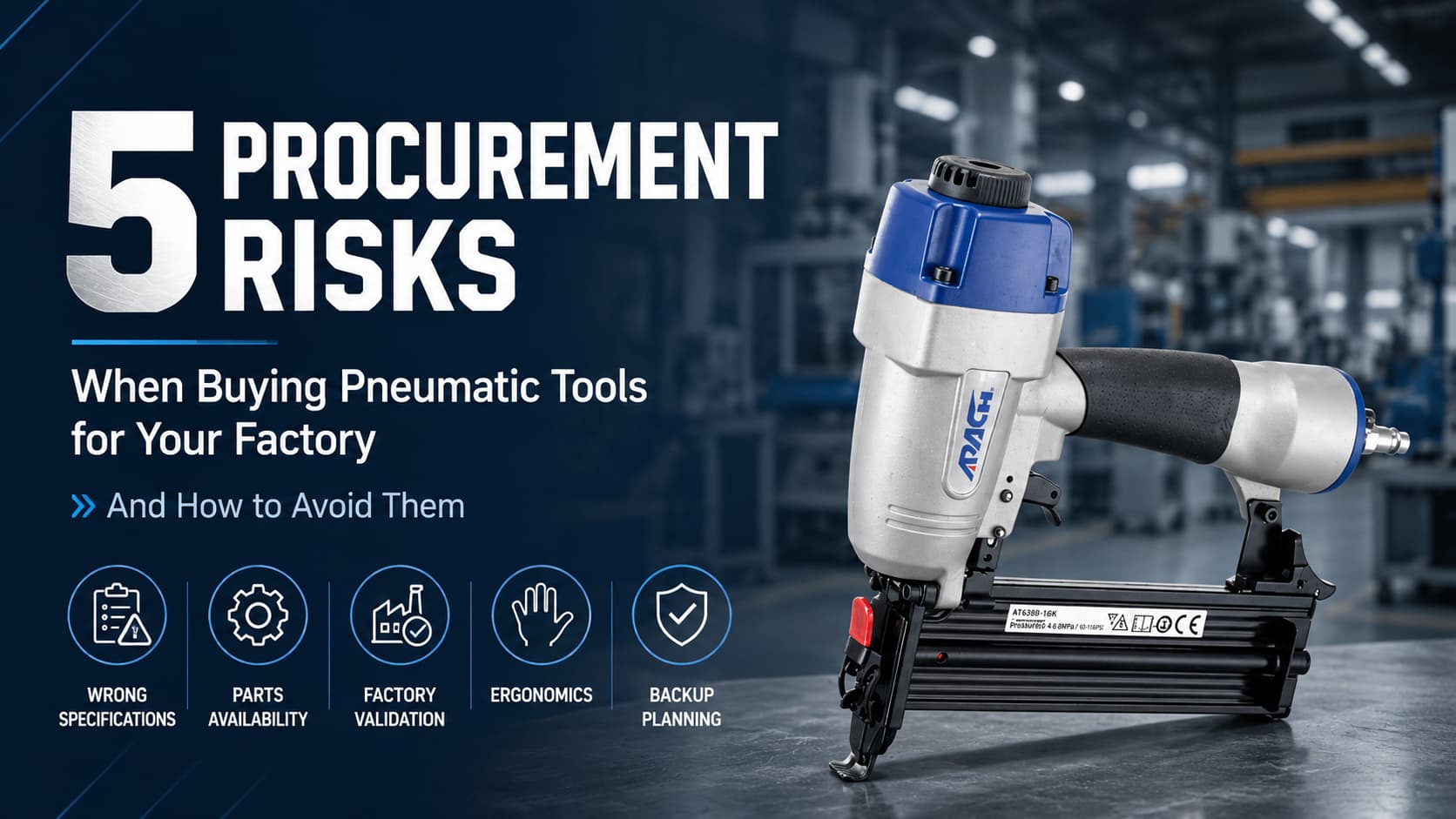
5 Procurement Risks When Buying Pneumatic Tools for Your Factory (And How to Avoid Them)
Introduction: The Hidden Cost of the Wrong Tool
When procurement managers evaluate pneumatic tools, the unit price is often the first — and sometimes the only — number on the spreadsheet. But experienced factory operators know the real cost of a tool is never just what you pay at purchase. A wrong specification, an unreliable supplier, or a poorly maintained tool can quietly drain thousands of dollars from your production budget every year.
This guide breaks down the 5 most common procurement risks in industrial pneumatic tools — and how to avoid each one before it impacts your bottom line.
Risk 1: Choosing the Wrong Gauge — and Paying for It in Rework
Perhaps the most frequent and costly mistake is selecting a nailer gauge that doesn't match your primary material or application.
- Too heavy (e.g., 15-Gauge on thin MDF): The thicker nail shank can split delicate materials, resulting in rejected parts, rework labor, and wasted stock.
- Too light (e.g., 16-Gauge on structural hardwood joints): Insufficient holding power leads to weak assemblies that fail quality inspection — or worse, fail in the field.
How to Avoid It: Before issuing an RFQ, map your production line's material types and joint requirements. Request a technical specification sheet from your supplier and ask for gauge recommendations by application. A reliable manufacturer like Apach will provide this guidance as standard.
Risk 2: Supplier Parts Discontinuation — When Maintenance Becomes Impossible
A tool that runs flawlessly for two years is worthless if the O-ring kit or driver blade is discontinued. Parts availability is a lifecycle issue that procurement teams often overlook in the initial purchase decision.
- Smaller or unestablished brands may exit the market or discontinue model lines within 2–3 years.
- Without replacement parts, even minor tool failures require full unit replacement — at full purchase price.
How to Avoid It: Ask your supplier directly: "What is your parts availability commitment for this model?" Look for manufacturers with a proven track record of at least 5–10 years in industrial markets and who maintain regional spare parts inventory. Evaluate whether consumables (nails, O-rings, driver blades) are standardized across multiple models.
Risk 3: No Factory Validation — Buying Blind on Specs Alone
A data sheet can claim excellent durability, but only real-world validation data reveals whether a tool performs under continuous production conditions — high cycle counts, temperature variation, and operator handling.
- Catalog specifications are measured under ideal lab conditions, not the demanding reality of a factory floor.
- Inconsistent quality control at the manufacturer level results in batch-to-batch performance variation.
How to Avoid It: Request field test samples before committing to a bulk order. Define a 30-day pilot period with clear acceptance criteria: cycle count targets, jam rate thresholds, and surface finish pass rates. Document results and use them as the basis for supplier negotiation.
Risk 4: Ignoring Operator Ergonomics — The Hidden Productivity Drain
A tool that causes operator fatigue will reduce productivity far more than any spec sheet can quantify. Yet ergonomics rarely appears on a procurement checklist.
- Excessive tool weight increases fatigue during repetitive assembly tasks, reducing output per shift by an estimated 10–20%.
- Poor grip design or unbalanced weight distribution increases error rates and injury risk — both of which carry significant costs.
How to Avoid It: Involve your production supervisor and at least two experienced operators in the tool evaluation process. Have them assess weight, balance, trigger sensitivity, and magazine reload speed under realistic conditions. Ergonomic approval from the production team should be a mandatory step before purchase sign-off.
Risk 5: No Backup Unit Plan — When One Failure Stops the Line
Production lines run on uptime. A single tool failure without a backup unit can halt an entire assembly station — and the cost of one hour of downtime often exceeds the cost of the tool itself.
- Many procurement teams purchase the exact quantity needed for normal operations, leaving zero margin for failure.
- Emergency replacement orders — especially for imported tools — can take days or weeks, multiplying downtime costs.
How to Avoid It: Build a buffer unit policy into your procurement plan. A standard recommendation is to maintain one backup unit for every 5–8 active tools on the line. Factor this into your initial budget request and negotiate volume pricing with your supplier to reduce per-unit cost.
Procurement Checklist: 5 Risks at a Glance
| Risk | Warning Sign | Mitigation Action |
|---|---|---|
| Wrong gauge specification | High rework or split material rate | Map materials to gauge before RFQ |
| Parts discontinuation | Supplier unable to confirm parts lifecycle | Verify 5+ year parts commitment |
| No factory validation | Buying from spec sheet only | Run 30-day pilot with KPI criteria |
| Poor ergonomics | Operator complaints, rising error rate | Include operators in evaluation |
| No backup unit plan | Single tool failure causes line stoppage | Budget 1 backup per 5–8 active tools |
Conclusion: Procurement Strategy Is Production Strategy
The best procurement decisions aren't made by price alone — they're made by understanding the full risk landscape. By addressing gauge selection, supplier reliability, field validation, ergonomics, and backup planning before purchase, procurement managers can protect their production lines and demonstrate measurable value to their organization.
At Apach, we support procurement professionals at every stage — from specification consultation to long-term parts supply. Contact our industrial team to discuss your production requirements and find the right pneumatic solution for your line.