How to Choose the Right Coil Nailer: Understanding Apach Model Numbers and Finding the Best Fit for Your Job
A coil nailer is one of the most productive fastening tools available for high-volume applications such as pallet manufacturing, crate assembly, industrial packaging, fencing, roofing, framing, and prefabricated housing. Thanks to their large nail capacity and fast firing speed, coil nailers help professionals complete repetitive fastening tasks more efficiently than traditional nailing methods.
However, when comparing different models, many buyers ask the same question: Which coil nailer do I actually need?
At Apach, our coil nailer model numbers are designed to help users quickly identify the tool's capabilities and intended applications. Understanding these model numbers can make choosing the right tool much easier.
What Does the Number in a Coil Nailer Model Mean?
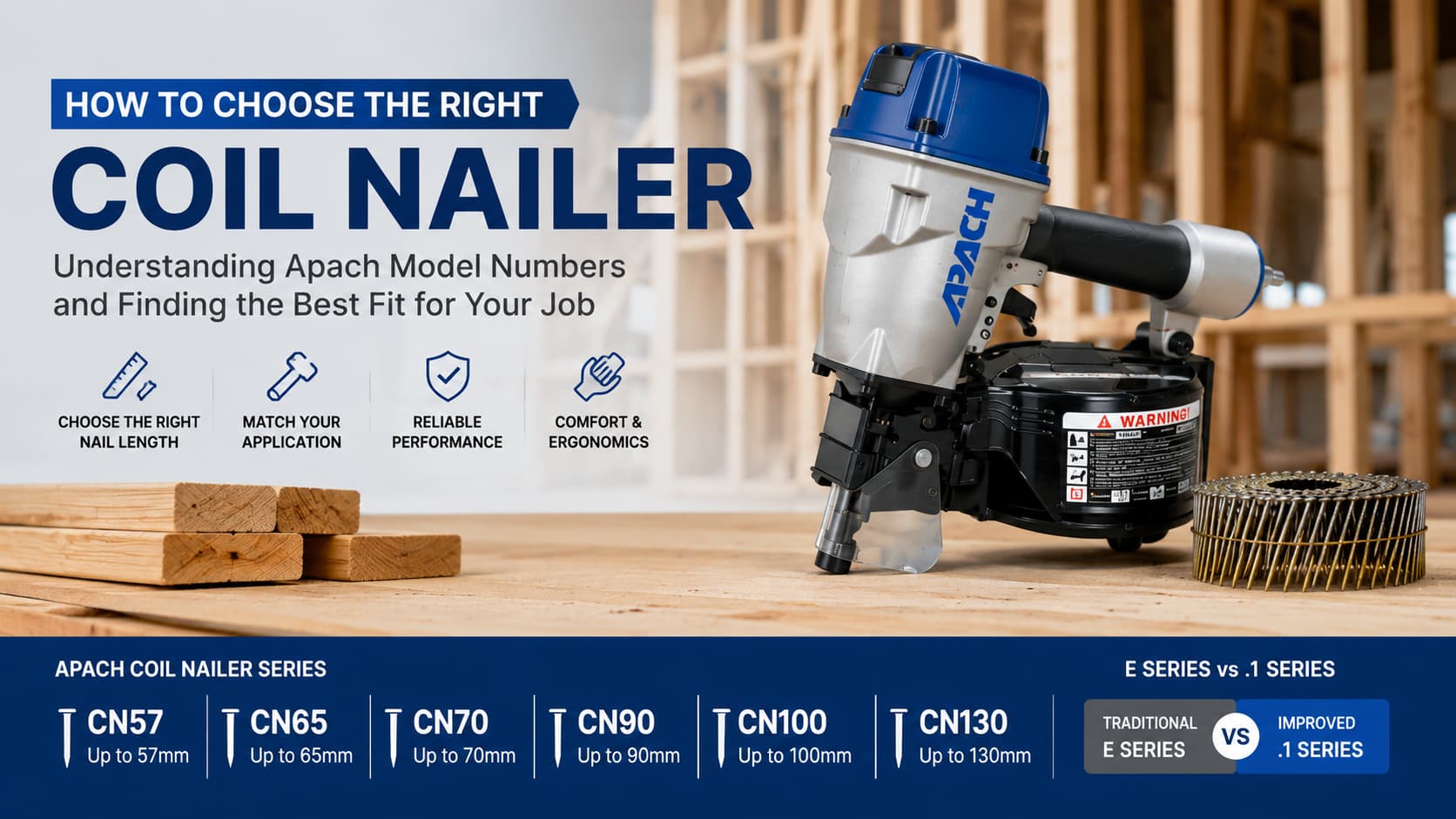
For Apach coil nailers, the number generally indicates the maximum nail length the tool can drive.
| Model | Maximum Nail Length |
|---|---|
| CN57 | Up to 57 mm nails |
| CN65 | Up to 65 mm nails |
| CN70 | Up to 70 mm nails |
| CN90 | Up to 90 mm nails |
| CN100 | Up to 100 mm nails |
| CN130 | Up to 130 mm nails |
In simple terms, larger numbers accommodate longer nails, and longer nails provide greater holding power. Different nail lengths are suitable for different applications, so selecting the correct nail length is the first step in choosing the right coil nailer.
Choosing a Coil Nailer Based on Your Application
CN57 and CN65 Coil Nailers
These models are commonly used for pallet manufacturing, wooden crate assembly, industrial packaging, fencing, and general woodworking. They provide excellent fastening performance while maintaining a relatively compact size and lighter weight.
CN70 Coil Nailers
The CN70 series is often considered one of the most versatile coil nailer categories. Common applications include heavy-duty pallet production, export crate manufacturing, industrial packaging, decking, and wood structure assembly.
For many manufacturers, a CN70 model offers an ideal balance between fastening strength and tool maneuverability.
CN90 Coil Nailers
When projects require greater holding power, CN90 models become a popular choice. Typical applications include wood framing, structural construction, timber assembly, and prefabricated housing.
The longer nail capacity allows for stronger fastening in thicker lumber and structural components.
CN100 and CN130 Coil Nailers
These models are designed for demanding heavy-duty applications, including timber construction, large wooden structures, industrial framing, prefabricated building systems, and heavy-duty wood manufacturing.
For projects that require maximum fastening strength, larger-capacity coil nailers provide the performance needed.
Understanding Apach E Series and .1 Series Models
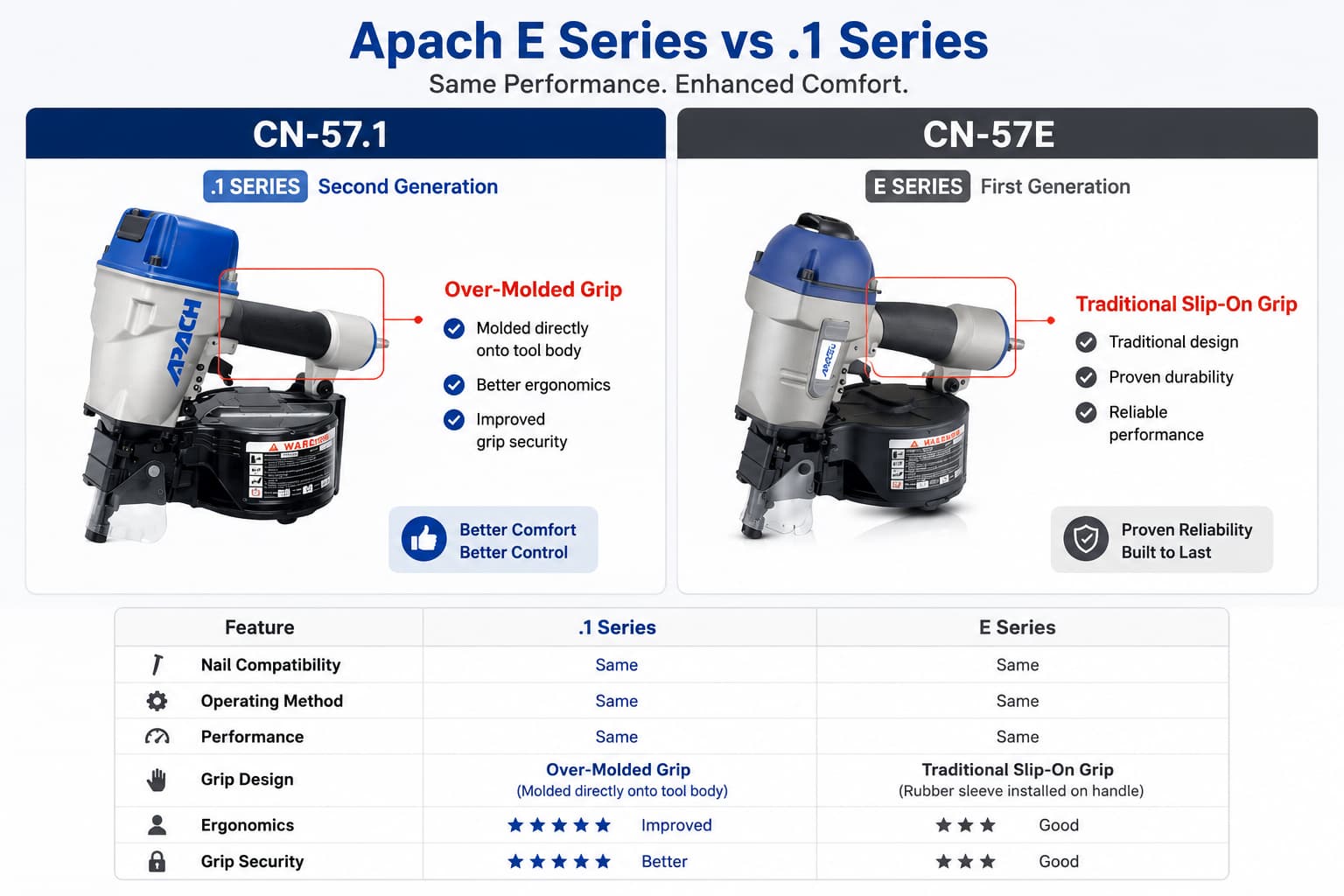
When browsing Apach coil nailers, you may notice models ending with .E or .1. Many buyers assume these represent different operating systems or nail specifications, but that is not the case.
The difference is primarily related to ergonomics and operator comfort.
E Series: Proven Traditional Design
The E Series represents Apach's first-generation design.
- Traditional exterior design
- Reliable operating mechanism
- Proven durability
- Slip-on rubber grip design
The handle grip is installed similarly to a motorcycle handlebar grip, using a sleeve-style rubber cover. For many users, this design continues to provide dependable performance in demanding production environments.
.1 Series: Enhanced Ergonomics and Comfort
The .1 Series represents the second generation of Apach coil nailers.
- Updated exterior styling
- Improved operator comfort
- Better grip security
- Enhanced ergonomics
Many .1 Series models feature an over-molded handle design, where the grip material is directly molded onto the tool body.
This design provides more secure handling, reduces the chance of grip slippage, improves comfort during long shifts, and enhances tool control and stability.
Do E Series and .1 Series Use Different Nails?
No. Both generations use the same nail specifications, operate in the same manner, deliver the same fastening performance, and serve the same applications.
The choice between E Series and .1 Series comes down primarily to personal preference regarding grip design and operator comfort.
Common Questions Buyers Ask When Choosing a Coil Nailer
Which Coil Nailer Is Best for Pallet Manufacturing?
For most pallet manufacturers, coil nailers in the 57 mm to 70 mm range are the most commonly used options. These models provide sufficient holding power for pallet deck boards while maintaining fast production speeds.
For manufacturers handling multiple pallet sizes, a CN70 coil nailer is often considered one of the most versatile choices because it balances fastening strength, nail capacity, and operator comfort.
What Is the Best Coil Nailer for Wooden Crates and Export Packaging?
Wooden crate manufacturers typically need a tool that offers strong fastening without unnecessary weight. Coil nailers in the 57 mm to 70 mm range are widely used because they provide reliable holding power while allowing operators to work efficiently throughout the day.
For heavier export packaging applications, longer nails and larger models may be recommended.
What Nail Length Should I Use for Framing Applications?
Framing applications generally require longer nails than pallet assembly or packaging work. Most contractors use nails ranging from 75 mm to 130 mm, depending on lumber thickness and local building requirements.
For this reason, CN90, CN100, and CN130 coil nailers are commonly selected for structural framing, timber construction, and prefabricated housing projects.
How Do I Know What Coil Nailer Size I Need?
The easiest way is to start with the nail length required by your application.
- 57 mm nails → CN57
- 65 mm nails → CN65
- 70 mm nails → CN70
- 90 mm nails → CN90
- 100 mm nails → CN100
- 130 mm nails → CN130
Once the nail length is determined, selecting the appropriate coil nailer becomes straightforward.
Can One Coil Nailer Handle Multiple Applications?
In many cases, yes. A versatile model such as a CN70 coil nailer can often handle pallet production, crate assembly, industrial packaging, fencing, and certain light construction applications.
However, structural framing and heavy timber construction usually require larger models capable of driving longer nails.
What Causes Coil Nailers to Jam Frequently?
Frequent jamming is often caused by incorrect nail specifications, low-quality nails, insufficient lubrication, dirt or debris inside the magazine, or worn feeding components.
Regular maintenance and using the correct nail size can significantly reduce downtime and improve productivity.
Which Coil Nailer Is Best for High-Volume Manufacturing?
For manufacturers focused on maximizing productivity, the best coil nailer is usually the one that matches the required nail length while remaining comfortable for operators during extended use.
Models in the 65 mm to 70 mm range are commonly used in pallet factories, packaging facilities, and woodworking operations because they provide an excellent combination of fastening strength, versatility, and handling comfort.
What Is Better for Daily Production: A Traditional Handle or an Over-Molded Grip?
For occasional use, both handle styles perform well. For production environments where operators use a coil nailer for several hours every day, over-molded grips often provide improved comfort and better control.
This is one of the reasons many users choose the newer .1 Series models.
Why Choose Apach Coil Nailers?
Apach has been manufacturing professional pneumatic fastening tools for customers worldwide for decades.
Our coil nailers are designed to provide high productivity, reliable performance, durable construction, consistent fastening quality, and comfortable operation.
From compact models designed for pallet production to heavy-duty tools built for structural framing, Apach offers a complete range of coil nailers to meet the needs of modern manufacturing and construction industries.
Conclusion
Choosing the right coil nailer starts with understanding your application and selecting the appropriate nail length. Once you've identified the required nail size, Apach's model numbering system makes it easy to find the right tool.
Whether you need a compact CN57 for packaging applications, a versatile CN70 for pallet production, or a powerful CN130 for heavy timber construction, Apach has a solution designed to maximize productivity and reliability.
Not sure which coil nailer is right for your project? Contact Apach today and let our team help you find the ideal fastening solution for your application.