Why Is My Air Impact Wrench Losing Power? (Complete Fix Guide)
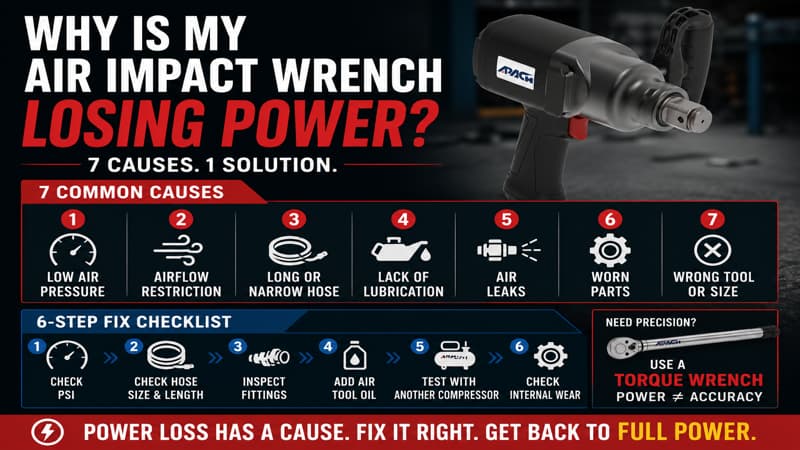
An air impact wrench usually loses power due to low air pressure (PSI), restricted airflow (CFM), poor lubrication, air leaks, or worn internal parts.
To fix it, check your air supply system, hose size, oiling, and internal components step by step.
Why is my impact wrench weak?
The most common causes are:
- Low air pressure (PSI too low)
- Insufficient airflow (CFM restriction)
- Long or narrow air hose
- Lack of lubrication
- Air leaks in fittings
- Worn internal parts
- Using the wrong tool for the job
Quick Diagnosis Table
| Problem | Likely Cause | Quick Fix |
|---|---|---|
| Weak torque | Low PSI | Set regulator to 90 PSI |
| Slow performance | Low CFM | Use larger hose |
| Inconsistent output | Air leaks | Check fittings |
| Noisy operation | No oil | Add air tool oil |
| Still weak after fixes | Internal wear | Repair or replace |
1. Low Air Pressure (PSI)
If your impact wrench is losing power, the first thing to check is air pressure.
Most tools require:
- 90 PSI at the tool, not just the compressor
Quick Fix:
- Adjust regulator
- Test pressure under load
2. Airflow Restriction (CFM Issues)
CFM, or airflow, is often more important than PSI.
Signs:
- Tool runs but feels weak
- Slower hammering
Causes:
- Long hose
- Small diameter
- Poor fittings
Quick Fix:
- Use 3/8" or larger hose, depending on how large your tool is
- Shorten hose length
Know why hoses and fittings are the key to power.
3. Lack of Lubrication
Without proper oiling, your tool loses efficiency quickly.
Symptoms:
- Reduced torque
- Increased friction
- Overheating
Quick Fix:
- Add 2–3 drops of air tool oil before use
4. Worn Internal Components
If air supply is correct, internal wear is likely the cause.
Common worn parts:
- Hammer mechanism
- Seals / O-Ring
- Anvil
Fix:
- Use repair kit
- Replace tool for heavy use
5. Incorrect Usage
Improper usage can reduce performance even if the tool is fine.
Mistakes:
- Wrong socket size
- Loose connection
- Improper extensions
- Wrong torque settings
Learn some common impact wrench mistakes.
6. Wrong Tool for the Job
Using an underpowered tool will always result in low performance.
Example:
- Light-duty wrench on truck bolts
Check heavy-duty impact wrench applications.
7. Underpowered Model
If your wrench consistently struggles, it may not meet torque requirements.
Solution:
- Upgrade torque rating
- Choose correct drive size
Check more:
Step-by-Step Troubleshooting
- Check PSI at the tool
- Check hose size and length
- Inspect fittings for leaks
- Add air tool oil
- Test with another compressor
- Check internal wear
When It’s NOT the Impact Wrench
If you need precision torque, use a torque wrench instead.
- Impact wrench = power
- Torque wrench = accuracy
Know the differences between impact wrenches and torque wrenches.
Pro Tips to Prevent Power Loss
- Use proper hose size
- Keep hose short
- Oil tool daily
- Use high-quality fittings
- Match compressor CFM
FAQ
1. Why is my impact wrench weak even at 90 PSI?
Because airflow (CFM), hose size, and leaks also affect performance—not just PSI.
2. How do I increase impact wrench power?
Increase airflow (CFM), shorten hose length, and ensure proper lubrication.
3. Does hose size affect impact wrench performance?
Yes. Smaller hoses restrict airflow and reduce torque output.
4. How often should I oil my impact wrench?
Before each use or daily for regular operation.